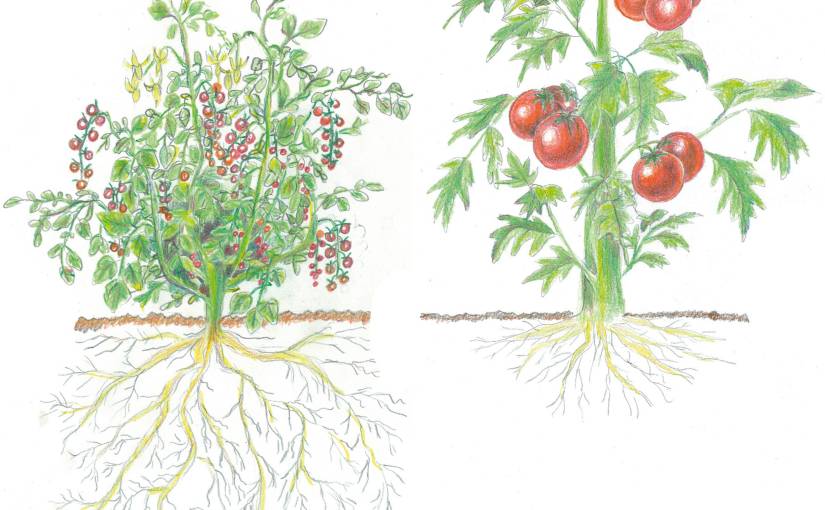
The process of domestication imparts radical changes to the anatomy and physiology of a species. In evolving to fulfill the new niches that humanity carved out millennia ago, cereal crops shed their ability to disperse their own seed, synchronized the timing of flowering and ripening, and swelled grain size by a massive degree. All of this to better fit the molds established by human cultivation and harvesting practices. The consequences of this shift, however, were the gradual loss of these species’ perennial nature.
The biological reason for this shift comes down to a change in strategy. Broadly speaking, annual agricultural species prioritize the rapid acquisition of resources over a short period of time to maximize the production of harvestable material. Usually, this is seed or fruit production, but some species, like carrots or spinach, are bred for fleshier roots or leaves. Perennial species, in contrast, invest in traits that allow them to survive for a longer period of time, dedicating fewer resources to initial seed production to ensure a longer period in which the plant can produce seed. The natural history of rice provides a useful illustration of this divergence. In the wild, it constructs denser root networks to better anchor it in marshy soils and adopts a lower canopy to keep the plant from toppling over (Chen et al., 2021). But under human cultivation, their roots shallowed and the canopy straightened to free up energy to subsidize greater seed production.
This domestication syndrome is largely why many of our cereal crops transitioned from a perennial to an annual lifecycle. This history also calls into question some of the current efforts to develop perennial grain crops.
The premise of breeding high-yielding perennial cereal crops is to create an agriculture that can maintain high levels of food production while reducing the environmental damage structurally inherent to annual crop production (Glover et al., 2010). Perennial plants massively reduce erosion and nitrogen runoff and increase soil carbon accumulation and water retention rates. These breeding programs hope to retain these ecosystem services as seed production is increased. Given the historical transition to annual lifecycles many crop domesticates have undergone, however, the concern is whether these efforts will result in some form of ecological dilution, where the beneficial functions of the species are sacrificed to underwrite productivity boosts.
An example of this phenomenon has been documented in improved varieties of the breadfruit tree, a staple in Polynesian diets. Domesticated varieties reported lower rates of soil fungi activity, and possibly lower soil carbon accumulation, than wild-type varieties (Gohd et al., 2026). And there are hints of ecological dilution in perennial grain domestication efforts as well. One study found that improved varieties of Kernza (a type of perennial wheat) are associated with lower microbial abundance in surrounding soils compared to wild-type lineages (Rodgers et al., 2025).
Until recently, there wasn’t much published experimental data noting direct reductions in ecosystem functions until recently. A paper published last year led by Argentine researchers from the National Scientific and Technical Research Council compares root structures across wild-type and domesticated lineages of perennial wheat to understand if this sort of ecological dilution occurs.
Overall, their findings are hopeful. They reported that, through each breeding cycle, leaf size and thickness, root length, and the quantity of fine roots all increased (Ravetta et al., 2025). The bigger leaves allow for higher rates of photosynthesis as well as transpiration, which draws up greater volumes of water. Longer, bushier roots allow the plant to access more belowground resource pools, and a greater proportion of fine roots increases the surface area with which the plant can draw in water and nutrients, increasing total resource acquisition rates. Other physiological changes resulting from domestication may also improve resource use efficiency. For example, the density of leaf veins increased following domestication, improving the rate of water movement into tissues. It’s also possible that various cellular structures evolved to curl the leaf more, reducing shade to improve sun exposure.
Deep roots are foundational to Kernza’s ecosystem services, so it’s a good sign that root traits tend to hold steady or improve as yields also increase. This study provides early evidence that multifunctional crops that furnish both high yields and soil improvements are possible.
However, the question remains: what evolutionary processes are allowing Kernza plants to attain productive grain production alongside ecosystem service? Wouldn’t energy budgets have shifted to prioritize some structures and deprioritize others, like what occurred in annual grain crops at the dawn of agriculture?
The evolutionary journey Kernza undertook over the course of its domestication wasn’t purely a redistribution of its resource budget, but an increase of total resource acquisition and use-efficiency. This freed up a large volume of new “capital” that could be spent in different areas. Grain production, stronger roots, bigger leaves. Dr. Robert Colautti calls this the ‘new house, new car’ model (Colautti, 2026). As the analogy goes, when a family increases their monthly income significantly, the choice is rarely to upgrade either the house or the car — generally speaking, as income goes up, most people increase their spending across budgetary categories. Perennial wheat domestication seems to have enhances how the plant acquires and uses resources, allowing it to make broad-based investments in multiple functions at once.
Interestingly, the evolution of a number of crops has not followed this pathway. During domestication, many species overspecialized in light acquisition and underinvested in traits associated with belowground resource acquisition and use-efficiency, as the luxurious availability of resources and relaxed competitive environment inherent to crop production reduced the need for such structures (Milla et al., 2014). The limiting factor in reproduction shifted from a broad base of stressors, like drought or nutrient deficiencies, towards just light, particularly in more recent rounds of crop evolution, where abundant agrochemical and modern irrigation further reduced the influence of such stressors. This has led to the decoupling of belowground and aboveground trait evolution, where selective pressures promote a smaller basket of traits, leaving the rest to either stagnate or wane.
As Kernza exits the first phase of its domestication, it’s a good sign that aboveground and belowground traits have remained integrated. Ensuring robust seed production while retaining vigorous roots is essential to realizing fruitful perennial grain crops. I don’t have a solid explanation for why Kernza has resisted decoupling; either breeders have been cognizant of root traits and worked to promote their evolution when making selection choices, or it’s simply quite early in the domestication timeline, and over time, the association between above and belowground traits will come under strain as more is demanded of the plant. Modelling suggests that we will one day hit the physical limits of enhanced acquisition and efficiency, and will have to draw carbon from plant stems and roots to reinvest in grain production if we want to push yields higher, potentially compromising environmental benefits (Kilbane, et al. 2025). Either way, breeders should keep their eye on belowground and efficiency-oriented traits and make every effort to sustain the association between high yields and perenniality.
What I’m Reading, Watching, and Listening to
The Truth about Rent Control: Discusses some of the newer strategies that mitigate the negative affects this policy has in cities in an attempt to keep neighborhoods intact while maintaining incentives to build housing and develop commercial spaces (non-paywalled link).